Defect Classification and Sorting
Go beyond pass/fail. Automatically classify defects by type and severity, route parts to the right corrective action, and build a consistent quality standard across every shift and every operator.
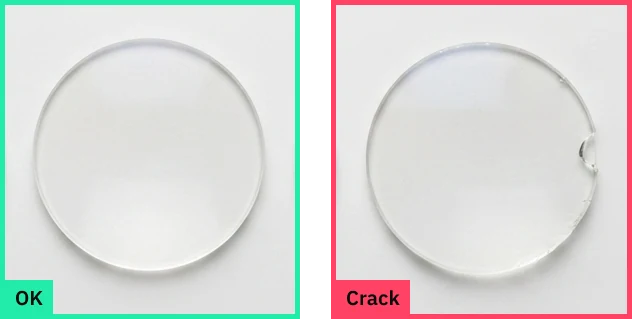
The AI tells you what the defect is, not just that one exists
Once a defect is detected, classification assigns it to a predefined category such as scratch, crack, contamination, or deformation. Your team acts on the right corrective action immediately. No more subjective judgment between operators or shifts. Over time, the defect database becomes a continuous improvement asset.
The right choice when:
Multiple defect types require different actions
When a scratch goes to rework but a crack goes to scrap, classification automates that routing decision without operator judgment.
Operator consistency is a problem
When quality decisions vary between shifts or individuals, classification enforces a single standard automatically.
You need defect trend analysis
When you want to understand which defect types are increasing, on which line, and on which shift, classification makes that data available.
Industries and applications
Plastic and metal parts
Sort scratches, sink marks, flash, and cracks automatically on moulded or machined components.
Food products
Classify burn marks, deformations, and contamination by severity before packaging.
Automotive surfaces
Route paint defects, dents, and scratches to the right corrective station automatically.
Electronic components
Separate repairable solder defects from critical failures on PCBs.
Optical lenses
Classify surface defects by type and severity across hundreds of lens references.
Packaging
Differentiate minor cosmetic issues from structural defects on packaging lines.
What makes it different
One standard, every shift
Classification decisions are defined once and applied identically. No operator subjectivity, no shift-to-shift variation.
Identify reworkable parts
Not every defect is scrap. Classification separates reworkable parts from rejects, reducing unnecessary waste.
Build a defect knowledge base
Every classified defect is stored with its image. Over time, this data drives root cause analysis and process improvement.
Do you have a defect classification or sorting use case?
Our vision engineers analyze your production case and deliver a tailored feasibility report at no cost, in under five days.